Connects to your ERP, your suppliers and your bank
Last updated 26 November 2026
Headless Procurement runs next to your ERP: requests, approvals, budgets, matching and supplier e-invoices happen here, and the approved result goes to the system you already keep your books in. Below is what each connector does today, and what it does not.
SAP (ECC and S/4HANA) · ORDERS05 IDoc
Approved purchase orders, and every later change order, become ORDERS05 IDocs with header, partner (vendor and approvers), line and delivery-date segments. Each IDoc passes a preflight check, is retried automatically with back-off, and the XML is kept with the order. A WE02-style monitor shows acknowledged, retrying and failed messages.
Limits today: Delivery to your SAP system uses your IDoc port or middleware; in our public demo no SAP system is attached, so acknowledgements are simulated.
Odoo (16 to 20; Odoo Online or self-hosted) · Purchase
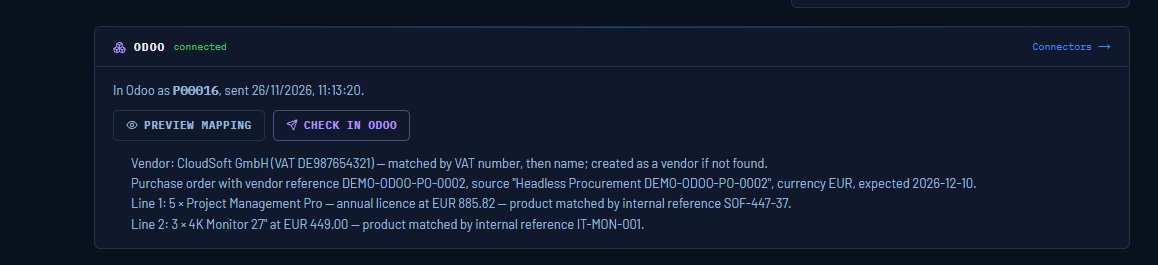
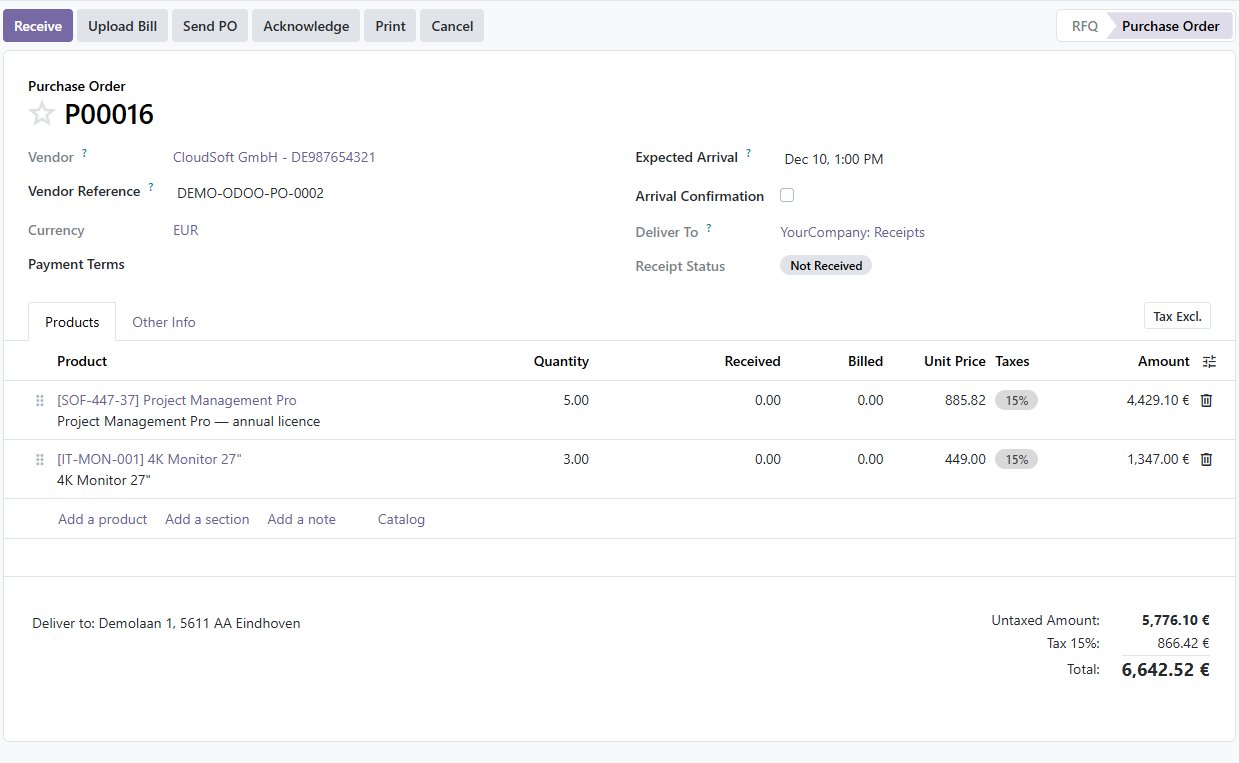
A purchase order is created in Odoo Purchase through Odoo's external JSON-RPC API. The vendor is matched by VAT number, then by name; products by internal reference (your SKU), then by name; anything missing is created. Our PO number becomes the Odoo vendor reference, so sending an order twice never creates a duplicate. Because the order is already approved here, it is confirmed in Odoo as a purchase order; you can choose to receive requests for quotation instead. Field names that differ between Odoo versions are checked with your server first, so an order is not refused over a renamed field. Every attempt is logged per order, and a preview shows exactly what will be created before anything is sent.
Limits today: Today the connector sends purchase orders. Receipts and vendor bills stay in Headless Procurement; syncing them back from Odoo is not built yet. VAT on the Odoo lines follows your Odoo product and fiscal-position settings.
Supplier catalogs · cXML PunchOut
Buyers punch out to a supplier's own web shop (PunchOutSetupRequest), shop there, and the cart comes back as a PunchOutOrderMessage that becomes a requisition with normal approvals. Orders to those suppliers can go out as a cXML OrderRequest.
Limits today: Each supplier needs its PunchOut URL and shared secret configured once.
E-invoices · UBL 2.1, EN 16931, Peppol BIS 3.0, XRechnung rules
Suppliers upload a UBL invoice or turn a purchase order into one. Each invoice is checked against the EN 16931, Peppol BIS 3.0 and XRechnung rules before it enters the three-way match; invoices that break a rule are refused with the rule code. Buyers can download the stored XML.
Limits today: Sending and receiving over the Peppol network needs a certified access point, which we do not run yet. CII (ZUGFeRD / Factur-X) is not read yet.
Banks · SEPA pain.001
Approved invoices are grouped into a payment run and exported as a SEPA credit-transfer file (pain.001.001.03) or CSV for upload to your bank; the run is then marked settled.
Limits today: No direct bank API; you upload the file in your banking portal.
Everything else · REST API and webhooks
A documented REST API (OpenAPI 3.1) and outbound webhooks for other systems, plus single sign-on for your users.
Limits today: Other ERPs (Exact, AFAS, Microsoft Dynamics, NetSuite) can be connected through the API today; native connectors are on request.
See it working
In the demo (sign in as the buyer), open any purchase order: the SAP IDoc card shows the generated IDoc and the Odoo card previews the Odoo order. Want it against your own SAP or Odoo test system? Book a demo.